2026 Zandvoort Historic Grand Prix report
Heat resistance
Author
- Mattijs Diepraam
Date
- June 23, 2026
Related articles
- Zandvoort - The quintessential GP track in the dunes, by Mattijs Diepraam
- Zandvoort - Historic crowd-puller, 2012 Historic GP report, by Mattijs Diepraam
- Zandvoort - Treasure in the dunes, 2013 Historic GP report, by Mattijs Diepraam
- Zandvoort - Seaside sensations, 2014 Historic GP report, by Mattijs Diepraam
- Zandvoort - Lucky stars, 2015 Historic GP report, by Mattijs Diepraam
- Zandvoort - Down to the wire, 2016 Historic GP report, by Mattijs Diepraam
- Zandvoort - Dune tragedy, 2017 Historic GP report, by Mattijs Diepraam
- Zandvoort - Epic sand fights, 2018 Historic GP report, by Mattijs Diepraam
- Zandvoort - Miracle in the dunes, 2020 Historic GP report, by Mattijs Diepraam
- Zandvoort - The boys were back in town, 2022 Historic GP report, by Mattijs Diepraam
- Zandvoort - Sunscreen, umbrellas and heated racing action, 2023 Historic GP report, by Mattijs Diepraam
- Zandvoort - Close contests, 2024 Historic GP report, by Mattijs Diepraam
- Zandvoort - Pass the Dutchie on the left-hand side, 2025 Historic GP report, by Mattijs Diepraam
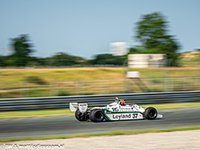
Who?Werner d'Ansembourg What?Williams-Cosworth FW07C Where?Zandvoort When?2026 Historic Grand Prix (June 19, 2025) |
 |
Why?
With two victories at a very hot Historic Grand Prix, Werner d’Ansembourg continued his triumphant run in the Masters Racing Legends series for historic F1 cars. The young Belgian, who is enjoying a very strong season, has now secured five wins from six starts in the Williams FW07C. In often searing conditions, Alexander Weiss, Stefan Mücke and Matteo Ferrer/Alexander Müller also recorded two wins from two races at the well-attended event at Zandvoort.
As usual, the entire history of Formula 1 from the first period of the Dutch Grand Prix from 1949 to 1985 was represented at the Historic Grand Prix. The Masters Racing Legends for F1 cars from the 3-litre era were once again the highlight of the programme, but with a generous field of 33 cars, the Historic Grand Prix Car Association (HGPCA) with its cars dating up to 1966 was certainly no less impressive. In fact, the 16-car entry in the 3-litre field was actually somewhat sparse compared to the larger grids seen earlier this year at Paul Ricard and Brands Hatch.
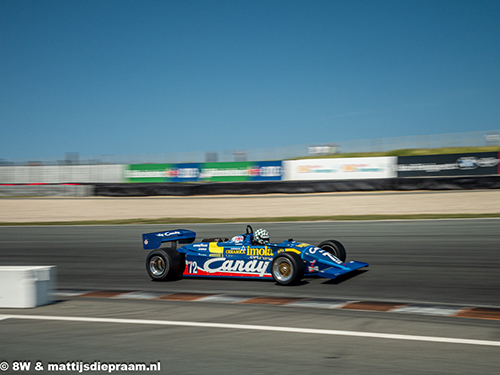
2024 champion Matt Wrigley came back to challenge Werner d'Ansembourg, but the young Belgian couldn't be stopped. (photo 8W)
In qualifying for the Masters Racing Legends, d’Ansembourg had secured pole position, as a result securing the best starting position for the weekend. The winner of both races at Paul Ricard and one of two at Brands Hatch went on to claim victory on Saturday, ending up 16 seconds ahead of Jamie Constable in a Tyrrell 011 and Warren Briggs in the McLaren M29. Meanwhile, the 2024 defending champion, Matt Wrigley, had started second but dropped back to fourth place, and as a result, he was able to start from pole in his Tyrrell 011 on Sunday’s partially reversed grid. He enjoyed the lead for seven laps before d’Ansembourg came storming by, having already passed Briggs and Constable. The top four from Saturday once again pulled away from the rest of the field on Sunday, but this time Constable failed to make it to the end of the race.
Yutaka Toriba had also been among the contenders, but his Williams FW07C broke down on Saturday, meaning he had to start from the back of the grid on Sunday. Charging through the field. the Japanese driver managed to finish fifth, trailing home Valerio Leone in the Arrows A6. The Monegasque driver had already claimed fifth on Saturday, and as a result doubled up on class wins in the post-82 class for later flat-bottomed cars. In the pre-78 class, John Spiers (March 761) and Ewen Sergison (Surtees TS9B) battled it out for glory, whilst Marty Bullock (Williams FW06) and Peter Williams (Lec CRP1) remained in contention. Spiers and Sergison fought fiercely for victory on Saturday, with the March ultimately coming out on top. Bullock and Williams followed them home in third and fourth, some 20 seconds behind. On Sunday, Spiers and Sergison were the only two remaining in class. This time, Spiers clinched a decisive class victory, crossing the line 45 seconds ahead of Sergison.
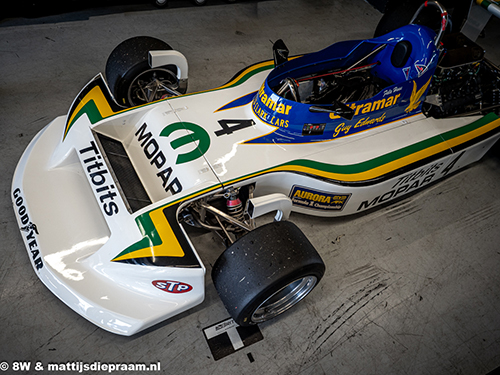
Felix Haas' ex-Guy Edwards March 781 was undoubtedly among the most remarkable cars at the meeting. (photo 8W)
Meanwhile, a remarkable car made its debut in the class: the March 781, which in 1978 had failed to complete a single lap during the Aurora race at Zandvoort, now completed 14 laps under the guidance of Felix Haas, although the German failed to finish either race. The 781 never competed in a World Championship event, but was developed at the request of Guy Edwards for Aurora AFX, the British F1 championship that succeeded the Shellsport series in 1978 and would continue until 1980.
Meanwhile, local favourite Michel Kuiper got his HGP weekend off to the best possible start by securing pole position in his Tasman-engined Brabham BT3/4 for the first of two HGPCA races for pre-66 Grand Prix cars. On Saturday, the Dutchman was on course for victory when he faltered a few laps from the end. Under heavy pressure from Michael Gans in the Cooper T79, Kuiper decided to take a gamble at the Slotemaker bend and squeeze between two considerably slower backmarkers. It soon became apparent that this was the wrong decision: the gap between the Talbot T26C driven by Kuiper’s compatriot Luc Brands and Ivo Smutny’s Alfa Romeo Tipo B was rapidly closing, causing the Brabham to hit the Alfa with its rear axle and subsequently collide with the Talbot. All three ended up in the gravel trap. The red flag was immediately waved, after which the result was determined on countback. However, this did not mean that Kuiper was declared the winner, as the stewards blamed him for causing the collision and imposed a 30-second penalty on the Dutchman. As a result, he dropped back to fourth place behind Gans, Tim Child (Brabham BT3) and Rüdi Friedrichs (Cooper T53).
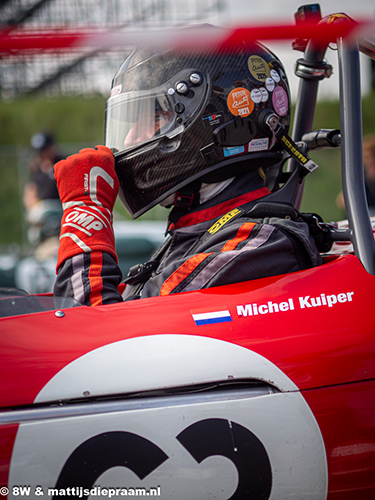
Local hero Michel Kuiper's best day came on Friday, when he secured pole position on his home track, but threw it all away in traffic the next day. He avenged himself with third on Sunday. (photo 8W)
On Sunday, the same four drivers battled it out for the top places, with Kuiper running in fourth for several laps. However, everything changed two laps from the end, when Child managed to find a way past Gans and, at roughly the same time, Kuiper managed to overtake Friedrichs. This meant the Dutchman was still able to enjoy the pleasure of a podium finish at his home race. In the race-within-a-race for front-engined cars, John Spiers and Guillermo Fierro shared the spoils between them in their Maserati 250Fs while Rod Jolley finished third twice in his Lister-Jaguar ‘Monzanapolis’, which demonstrates just how broadly the HGPCA interprets the concept of a ‘Grand Prix car’. Not only are F1 cars from 1947 onwards welcome, but also F2s from 1952-’53 and later (provided they have competed in World Championship races) , IndyCars up to 1960, South African F1 cars from 1961-‘65, Tasman cars up to 1965, Intercontinental cars from 1961 and, as is the case with the Lister, cars that competed in the two Race of Two Worlds events in 1957 and ’58.
Just as at Paul Ricard, the F2 & F3 Classic Interseries organised by French promoter HVM each staged two races supporting the top-tier single-seater races. In both F2 races, the battle was between the March 782s of Mark Charteris and Wolfgang Kaufmann, challenged by James Lay’s March 762. Lay had secured pole position but saw the two 782s overtake him on Saturday. The three then proceeded to lap in close formation, with Charteris ultimately taking the win, ahead of Kaufmann and Lay. The following day, it was much the same story until first Lay and then Charteris were forced to retire. This allowed Kaufmann to take a comfortable win, with the battling duo of Mark Dwyer (March 742) and HVM boss Laurent Vallery-Masson (March 77B) finishing half a minute behind.
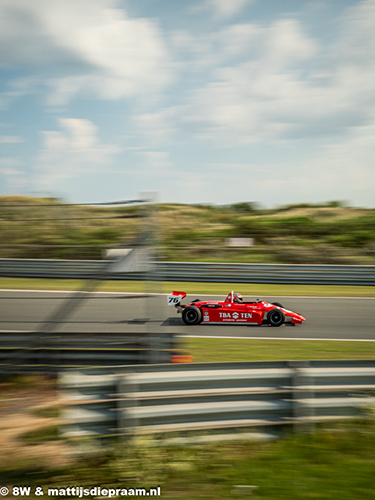
While Alexander Weiss came away with two more F3 Interseries wins, Dutchman Patrick Andriessen made life for the Dane harder than ever before in his Ralt-Alfa Romeo RT3. (photo 8W)
In the F3 series, Alexander Weiss was the clear favourite, having demonstrated considerable pace in 2025 using the Ralt-Alfa Romeo RT3 with which Giancarlo Fisichella had once claimed the Italian F3 title. Although Weiss did manage to win both races, it was by no means a walk in the park. On Saturday, Patrick Andriessen stole the show, driving his RT3, also powered by a Novamotor Alfa engine, all the way up from the back to secure second place, a mere seven tenths adrift of Weiss, with Davide Leone in the March-Toyota 783 hot on the Dutchman’s heels. On Sunday, Andriessen and Leone once again chased the Dane, who this time managed to open up a gap of around two seconds.
The sportscars on the programme were provided by Masters, although the turnout in both cases was fairly disappointing. The Masters Sports Car Legends were represented by just nine cars, in what has been scaled back to a mini-championship spanning two weekends this year. Olivier Hart dominated both races in the Ferrari 512M. On Saturday, it was more of a glorified test drive, after the young Dutchman had lapped the rest of the field by one and a half laps. On Sunday, Hart Jr started from the pits to make things a bit more challenging, but he still regained the lead after four laps. The strongest challenge came from Michael Gans in the Lola T70 Mk3B – a car previously always driven by his good friend Jason Wright – followed by the McLaren M1B driven by John Spiers and Nigel Greensall, both cars securing the same podium positions each day. Nicky Pastorelli was unable to start on Saturday, but in the Roelofs Engineering Ferrari 365 GTB/4 Daytona finished fifth on Sunday behind the Lola T290 driven by Alexander Collins and Martin Stretton.
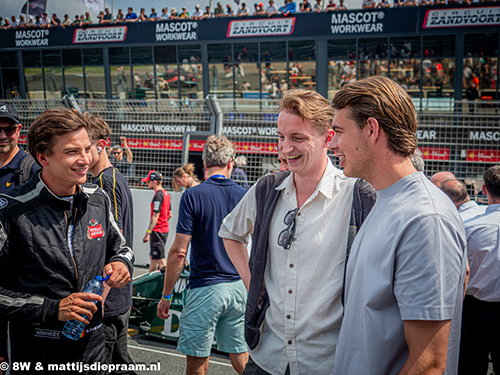
Fresh from his strong Le Mans debut, multiple F2 race winner Richard Verschoor was one of the many local stars who graced the F1 gridwalk with their presence. Here he is on the right, chatting away with Werner d'Ansembourg on the left. (photo 8W)
Due to a lack of cars, the Masters Endurance Legends 1 (for LMP1/2 and GT1/2 cars) and Masters Endurance Legends 2 (for LMP3, GT3/GT4 and Cup and Challenge cars) grids were merged into one, creating a single field of 15 cars, 12 of which ultimately lined up on the grid for both races. A week before the next Supercar Challenge weekend at Zolder, Koopman Racing provided a welcome addition in the form of two BMW M6 GT3s for Daan Meijer and Marlon Birdsall/Mex Jansen. In addition, Hein Koopman himself took to the track in ‘Zetti’, the team’s popular BMW Z4 GT3. Both races were won with relative ease by Matteo Ferrer/Alex Müller in the Chevrolet Corvette DP. The one-off duo of Birdsall/Jansen distinguished themselves on both days with an overall podium finish and victory in the GT class. On Saturday, the two young talents also managed to stay ahead of Karl Pedraza’s Ligier LMP3, while on Sunday, Meijer finished fifth behind Danny Baker’s ORECA 03 (LMP2), whilst Koopman fought Jac & Ties Meeuwissen’s Ferrari 488 Challenge for ninth place overall over the two days.
Similarly, the Masters Gentlemen Drivers & Pre-66 Touring Cars field was a shadow of its former self: 18 GTs (the majority of which were Dutch and German one-off entrants) and two touring cars made up the final entry. This time, the GTs did not race for 90 minutes but instead, like the touring cars, they were to be flagged off after one hour. The battle at the front was to be an all-Dutch affair: Olivier Hart initially led the field in the Shelby Cobra Daytona Coupé, battling it out with the two Ferrari cars from Roelofs Engineering. When Hart was forced to retire, Yelmer Buurman and Nicky Pastorelli settled the battle between themselves, with Buurman in the 250 LM eventually pulling away from Pastorelli in the 250 GTO ’64 by six seconds. Ten ticks further back, Nigel Greensall in John Spiers’ TVR Griffith managed to pip Nicolai Kjaergaard for third. In his Lotus Elan 26R, the fast young Dane did, however, win the CLP class, staying ahead of the AC Cobra driven by Bas Jansen and Chris Chiles Jr. Behind Felix Haas’s Ginetta G4R, the Meeuwissens finished seventh in their Shelby Cobra Daytona Coupé, which had suffered from clutch problems and a sticking accelerator pedal just the day before. In 11th place, Geoff & Alan Letts crossed the line in their Lotus Cortina as winners of the touring car class. Their only rivals, local father-and-son duo Henk & Thijs van Gammeren, failed to finish in their Ford Falcon Futura Sprint.
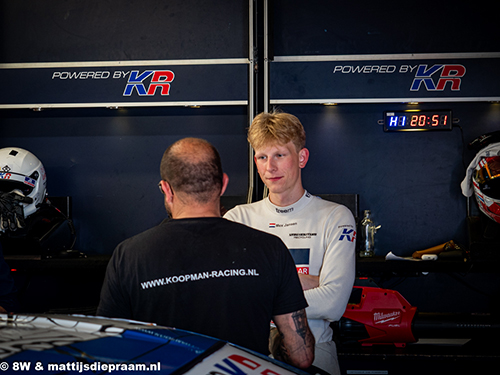
Along with the two Rappange brothers (Jop and Dante) who have extensive experience in historic racing, Mex Jansen joined the hungry pack of young Dutch GT stars that wanted to experience the joys of racing at a historic event. Here he is seen talking to his team boss Hein Koopman. (photo 8W)
Two extremely strong Dutch grids more than made up for the relative lack of Masters cars. The SuperSixties began their qualifying session with a surplus of 55 cars, eventually starting both races with the maximum of 47 cars. In Michiel Campagne’s Chevrolet Corvette Grand Sport, Allard Kalff led the first race from start to finish, although Chris Chiles Jr in the Cobra kept him on his toes throughout the race. Behind the pair, Andy Newall, in Rhea Sautter’s Jaguar E-type, powered his way to third place, ahead of Jan van der Kooi’s Lotus Elan 26R and Jop Rappange’s Porsche 904/6. On Sunday, Campagne and Jansen looked set to mirror their team-mates’ final positions from the day before, but with two laps to go, the entire top four was turned on its head, Jansen notching up the win, whilst Van der Kooi and, this time, Dante Rappange in the 904/6 managed to push Campagne back to fourth place.
In the touring car class, the Van der Ende family were at the front of the field on two occasions: on Saturday, son Jack won, whilst on Sunday, father Jaap finished second after a fierce battle with Thijs van Gammeren. The other Falcons driven by Carlo Hamilton, former Le Mans winner Volker Weidler and Tim Scott Andrews were also in the thick of the action.
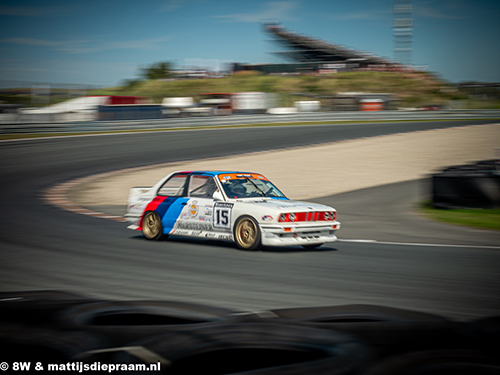
BMW E30 M3s came to the fore in the brace of NK HARC 82-90 races. Pieter Bikker's M3 was sandwiched by Leonard Batenburg and Alexander van der Lof's examples, but dominated Sunday's proceedings. (photo 8W)
Meanwhile, BMW M3s set the pace in a field of 40 cars for the NK HARC 82-90. Leonard Batenburg secured victory on Saturday for Vink Motorsport, followed by the M3s of Pieter Bikker and Alexander van der Lof, with Van der Lof harried by the fastest 944 3.0 driven by Ruben Nooy. In the absence of Batenburg and Van der Lof, multiple champion Pieter Bikker had the field to himself on Sunday: his M3 trounced the two 944 3.0s driven by Nooy and Jeroen van Breda.
Finally, the Tourenwagen Legenden rounded off the programme with two races featuring a packed field of DTM and DRM cars – or at least, those were among them, as the definition was applied rather broadly given the presence of, amongst others, various relatively modern Porsche GTs, a couple of distinctly audible V8-STARs and even a Mini GTR. Former DTCC champion Donald Molenaar started from pole twice in his BMW E36 M3, but the joy of that was only temporary on both occasions. Stefan Mücke made things a bit more entertaining for himself on both days by qualifying at a relatively leisurely pace, only to then cut through the field in his screaming Mercedes C-Class DTM. On both occasions, the gap to Molenaar was over 40 seconds.